
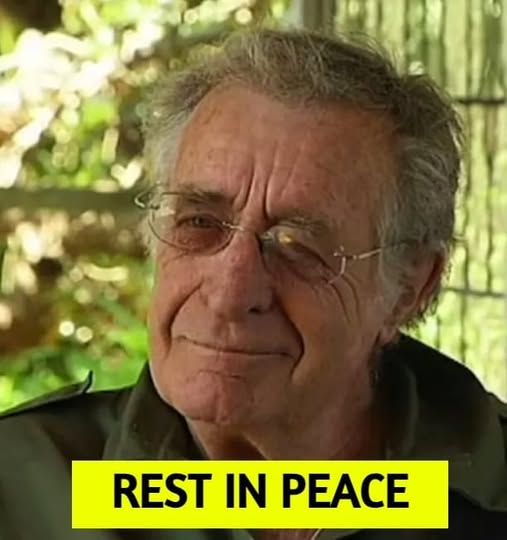
For decades, he made danger look almost supernatural.
Cars flipping through explosions. Bodies crashing through glass. Fire roaring across asphalt while cameras kept rolling. Audiences watched him survive scenes that looked impossible, and somewhere over time, people began believing men like him existed outside ordinary fragility.
But death rarely arrives cinematically.
And for Grant Page, one of the most legendary stunt performers connected to the Mad Max universe, the end came not during an orchestrated explosion or carefully planned action sequence, but alone on a quiet road in New South Wales at eighty-five years old.
The irony feels almost unbearable.
A man who spent a lifetime cheating gravity, crashing vehicles, leaping through flames, and surviving controlled chaos was ultimately claimed by the same ordinary danger millions of people face every day without cameras watching.
According to those close to him, Grant remained deeply alive right until the end. His son Leroy described him as energetic, motivated, and still filled with creative plans. Even in his eighties, he reportedly continued discussing films, ideas, and projects with the restless excitement of someone who never truly stepped away from the adrenaline that shaped his life.
That may be what makes his death feel so emotionally striking to people who admired him.
Not simply that he died.
But that he never really stopped living at full speed first.
Within Australia’s film industry, Grant Page was more than a stuntman. He belonged to an era of filmmaking where practical effects demanded terrifying levels of physical courage from performers willing to place their bodies directly inside danger for the sake of realism. Before digital effects softened risks artificially, stunt performers like Page became the hidden architecture beneath action cinema itself.
Audiences saw actors become heroes.
But often it was people like Grant Page setting themselves on fire, launching vehicles off cliffs, or hurling themselves through violent collisions behind the scenes to make those moments believable.
And by nearly every account, he approached that work with fearless intensity.
Directors and colleagues frequently described him as possessing an almost instinctive understanding of motion and risk — a man whose relationship with vehicles bordered on mythological. He drove through chaos with unnerving precision. Crashed spectacularly. Survived impacts that looked fatal even during rehearsals.
Stories surrounding him gradually became larger than life.
Fighting sharks.
Sliding burning down embankments.
Jumping between speeding cars.
Over time, Grant Page stopped feeling like an ordinary man to many people.
He became part of the mythology surrounding action cinema itself.
Which is why the image of his final moments feels hauntingly human by comparison.
No cameras.
No roaring audience.
Just an elderly man driving alone through New South Wales while emergency crews rushed toward a scene they could not reverse in time.
And perhaps that contrast says something deeper about mortality itself.
Because no matter how legendary someone becomes, life eventually strips away spectacle in the end. What remains are not explosions or headlines, but the quieter truths underneath: family, unfinished plans, conversations interrupted too soon, people suddenly forced to imagine a world without someone who always seemed indestructible.
In the days following his death, tributes spread quickly throughout Australia’s film community and beyond. Fellow filmmakers, actors, critics, and stunt professionals remembered not only his technical brilliance but his energy — the almost contagious passion he brought into rooms even late in life.
To younger stunt performers especially, Grant represented a bridge to a rawer era of filmmaking where physical courage carried genuine consequences.
An era before computer-generated safety softened everything.
He leaves behind four sons, former partners, colleagues, and generations of filmmakers shaped by his work. But perhaps his deeper legacy exists in every action sequence audiences still feel physically instead of merely watching. Every crash that looks terrifying because someone real risked something real to create it.
That legacy cannot be fully digitized or replaced.
And maybe that is why his story resonates emotionally now.
Because beneath all the explosions and cinematic mythology, people are mourning something larger too:
A disappearing kind of fearlessness.
A man who spent his life racing directly toward danger for the sake of spectacle, art, and adrenaline — and somehow carried that spirit with him all the way to eighty-five.
Now the engines have finally gone quiet.
But for those who grew up watching impossible stunts unfold on screen, Grant Page still feels less like someone who vanished and more like someone who left skid marks across film history itself.