
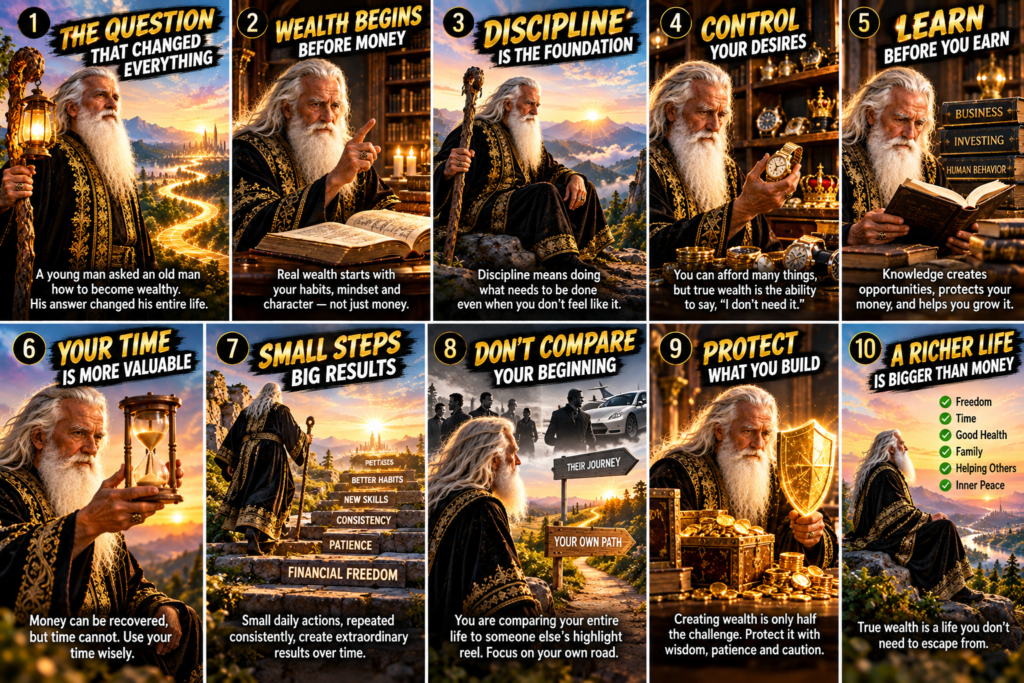
The Old Man Who Knew the Secret of Wealth
There was once an old man who lived alone in a small house at the edge of a quiet town.
He had long silver hair, a magnificent white beard, and eyes that seemed to have witnessed generations come and go.
People in the town called him many names.
Some called him a scholar.
Others called him a magician.
A few simply called him the old man who understood life.
But there was one thing everyone agreed on:
Whenever someone asked him how to become wealthy, he never talked about money first.
Instead, he talked about discipline.
And one evening, a young man finally asked him why.
1. The Question That Changed Everything
The young man’s name was Daniel.
He was hardworking, but he was frustrated.
Every morning he woke up thinking about money.
Every night he went to bed thinking about money.
He watched videos about success.
He read books about millionaires.
He searched for business ideas.
He looked for investments that might make him rich quickly.
But despite all his effort, his financial situation seemed unchanged.
One evening, he walked through the forest and found the old man’s house glowing warmly in the darkness.
Daniel knocked on the wooden door.
The old man opened it.
“Why have you come?” he asked.
Daniel looked at him and said:
“I want to become wealthy. Tell me the secret.”
The old man smiled.
Then he pointed toward a wooden chair.
“Sit.”
Daniel sat down.
The old man placed an ancient book on the table.
Then he said something Daniel never expected.
“If you want wealth, stop chasing money.”
Daniel looked confused.
“Then what should I chase?”
The old man replied:
“Become the kind of person who can create, protect, and grow wealth.”
2. Wealth Begins Before Money
The old man opened his ancient book.
Its pages were filled with handwritten notes, diagrams, and lessons.
“Most people believe wealth begins when they receive more money,” he said.
“But real wealth often begins much earlier.”
“It begins with your habits.”
Daniel listened carefully.
The old man continued.
“If someone earns a million dollars but spends every dollar they receive, they are not financially free.”
“If another person earns less but consistently saves, learns, builds skills, and invests carefully, they may eventually create something far more valuable.”
Daniel asked:
“So money isn’t the beginning?”
“No,” said the old man.
“Money is a tool.”
“The person holding the tool determines what happens next.”
3. The First Lesson: Discipline
The old man walked toward the window.
Outside, the sun was beginning to rise.
“Look at the sun,” he said.
“It appears every morning whether people feel motivated or not.”
“That is discipline.”
Daniel remained silent.
The old man explained that motivation is temporary.
Some days you feel excited.
Some days you feel powerful.
Some days you want to work for twelve hours.
But other days, you want to stay in bed.
“If your success depends on motivation,” the old man said, “your progress will always be unstable.”
“Discipline means doing what needs to be done even when you don’t feel like doing it.”
That lesson stayed with Daniel.
4. The Second Lesson: Control Your Desires
The old man then showed Daniel a room filled with beautiful objects.
There were expensive watches.
Golden ornaments.
Fine clothing.
Rare books.
And valuable paintings.
Daniel looked around in amazement.
“You have all these things?”
The old man smiled.
“Some people spend their entire lives trying to own things that eventually own them.”
Daniel didn’t understand.
The old man explained:
“If you constantly need something new to feel successful, there will never be enough.”
One expensive phone becomes another.
One car becomes another.
One house becomes another.
One luxury becomes another.
“The problem isn’t enjoying good things,” the old man said.
“The problem is becoming dependent on them for happiness.”
True wealth, he explained, includes the ability to say:
“I can afford it, but I don’t need it.”
5. The Third Lesson: Learn Before You Earn
The old man placed three books in front of Daniel.
One was about business.
One was about investing.
The third was about human behavior.
“Which one should I read?” Daniel asked.
“All three,” the old man replied.
“Why?”
“Because earning money requires a skill. Keeping money requires discipline. Growing money requires knowledge.”
The old man told Daniel that people often want financial results without developing financial understanding.
They want the reward without learning the rules.
They want the destination without understanding the road.
“Never be embarrassed to start as a beginner,” he said.
“Every expert once knew nothing.”
6. The Fourth Lesson: Your Time Is More Valuable Than Your Money
Daniel asked:
“What is the most valuable thing I own?”
The old man answered immediately.
“Your time.”
Daniel expected him to say money.
But the old man shook his head.
“Money can sometimes be recovered.”
“Time cannot.”
“You can lose money today and potentially earn it again tomorrow.”
“But yesterday will never return.”
The old man encouraged Daniel to stop wasting hours on things that added nothing to his future.
He told him to ask himself every morning:
“What am I doing today that my future self will thank me for?”
That single question changed Daniel’s daily routine.
7. The Fifth Lesson: Small Steps Become Great Results
Daniel wanted to change his life immediately.
He wanted to wake up wealthy.
He wanted a successful business.
He wanted financial freedom.
But the old man gave him a different assignment.
“Save a small amount.”
“Learn one useful skill.”
“Read a few pages.”
“Exercise.”
“Work consistently.”
“Repeat tomorrow.”
Daniel laughed.
“That’s it?”
The old man smiled.
“People underestimate small actions because they cannot see where those actions lead.”
A tree does not become enormous overnight.
A building does not appear in one morning.
A successful business does not become successful in a single afternoon.
Great results are often the visible outcome of thousands of small decisions.
8. The Sixth Lesson: Stop Comparing Your Beginning to Someone Else’s Middle
One of Daniel’s biggest problems was comparison.
He constantly looked at people online.
Someone bought a new car.
Someone purchased a house.
Someone launched a business.
Someone posted a photograph from an expensive vacation.
Daniel felt behind.
The old man told him:
“You are comparing your entire life to someone’s highlight reel.”
Then he said:
“You don’t know how long their journey took.”
“You don’t know their failures.”
“You don’t know their sacrifices.”
“You don’t know their circumstances.”
“Build your own road.”
The lesson was simple:
Comparison steals energy that could have been used for progress.
9. The Seventh Lesson: Protect What You Build
After several months, Daniel began earning more.
His skills improved.
His confidence grew.
He started saving money.
But the old man wasn’t impressed.
Instead, he asked:
“Can you protect it?”
Daniel didn’t understand.
The old man explained that creating wealth is only half the challenge.
Protecting it matters too.
Avoid reckless decisions.
Understand risks.
Don’t place everything into one opportunity.
Don’t trust promises simply because they sound attractive.
And never invest money you cannot afford to lose without understanding what you are doing.
“Greed makes people careless,” the old man said.
“Patience makes people thoughtful.”
10. The Eighth Lesson: Failure Is Not the Opposite of Success
One winter, Daniel’s first small business failed.
He lost money.
He felt embarrassed.
He returned to the old man’s house.
“I failed,” Daniel said.
The old man poured him a cup of tea.
“Good.”
Daniel stared at him.
“Good?”
“Yes.”
“You learned something that success could not teach you.”
Daniel looked confused.
The old man continued:
“Failure becomes dangerous only when you refuse to learn from it.”
He told Daniel to study what went wrong.
Was the idea weak?
Was the planning poor?
Were expenses too high?
Did he misunderstand his customers?
Did he move too quickly?
Failure became a teacher.
Daniel stopped asking:
“Why did this happen to me?”
He started asking:
“What can this teach me?”
11. The Ninth Lesson: Choose Your Circle Carefully
The old man then asked Daniel to describe his closest friends.
Daniel mentioned people who constantly complained about life.
People who mocked ambition.
People who spent everything they earned.
People who believed success was impossible.
The old man listened.
Then he said:
“Your environment matters.”
He didn’t tell Daniel to hate his old friends.
He told him something more important.
“Respect everyone, but choose carefully who influences your decisions.”
Spend time around people who encourage learning.
People who work.
People who think long-term.
People who accept responsibility.
People who celebrate your progress rather than secretly hoping you fail.
“Your environment doesn’t determine your destiny,” the old man said.
“But it can influence your direction.”
12. The Tenth Lesson: Don’t Search for Overnight Wealth
Daniel eventually asked the question he had been avoiding.
“Can I become rich quickly?”
The old man laughed.
“Sometimes people become wealthy quickly.”
“But you should never build your life around the assumption that it will happen to you.”
There are no magical shortcuts that guarantee wealth.
There is no secret button.
There is no perfect investment that removes all risk.
There is no guaranteed business idea.
The old man said:
“If someone promises you enormous returns with no risk, your first reaction should not be excitement.”
“It should be caution.”
Real progress may feel boring.
Saving can feel boring.
Learning can feel boring.
Building a business can feel boring.
But boring consistency can produce extraordinary results over time.
13. The Eleventh Lesson: Health Is Part of Wealth
One morning, the old man refused to talk about money.
Instead, he took Daniel outside.
They walked through the forest.
After an hour, Daniel was exhausted.
The old man wasn’t.
“You are chasing financial wealth while ignoring another kind of wealth,” he said.
“Your health.”
What good is money if you have no energy to enjoy your life?
What good is success if you destroy yourself achieving it?
The old man encouraged Daniel to sleep properly, move his body, eat reasonably, manage stress, and take care of his health.
“Your body is the vehicle that carries you toward every goal.”
14. The Final Lesson: Wealth Is Bigger Than Money
Years passed.
Daniel eventually became successful.
He built businesses.
He invested carefully.
He helped his family.
He created opportunities for other people.
But something had changed.
He no longer measured his life only by his bank account.
He measured it by freedom.
By time.
By relationships.
By health.
By knowledge.
By the people he helped.
One evening, Daniel returned to the old man’s house.
But the house was empty.
On the table was the ancient book.
Daniel opened it.
On the final page were seven words:
“Build a life you don’t need to escape from.”
Daniel smiled.
He finally understood.
The old man had never really been teaching him how to become rich.
He had been teaching him how to become strong enough to handle success.
15. The Secret Was Never a Secret
Years later, people began asking Daniel how he became successful.
They expected complicated answers.
They expected secret investments.
They expected hidden business strategies.
They expected some mysterious formula.
Daniel always gave them the same answer.
“Start with discipline.”
“Learn.”
“Save.”
“Build useful skills.”
“Take calculated risks.”
“Protect what you have.”
“Take care of your health.”
“Be patient.”
“And don’t let money become the only measure of your life.”
People often looked disappointed.
They wanted something more exciting.
But Daniel understood something they didn’t.
The most powerful principles are often the simplest.
The difficult part isn’t discovering them.
The difficult part is practicing them every day.
Your Wealthy Future Starts With One Decision
Maybe you’re reading this while struggling financially.
Maybe you’re working long hours and wondering when things will finally change.
Maybe you’ve made mistakes.
Maybe you lost money.
Maybe you started something that didn’t work.
Maybe you’re tired of watching other people succeed while you’re still trying to figure out your own path.
If that’s you, remember Daniel’s story.
You don’t need to transform your entire life tonight.
Start with one decision.
Wake up tomorrow and learn something useful.
Control one unnecessary expense.
Spend one hour building a valuable skill.
Take one step toward your goal.
Then repeat it.
And repeat it again.
Because your future isn’t built in one dramatic moment.
It is built quietly.
One morning.
One decision.
One habit.
One lesson.
One opportunity.
One disciplined day at a time.
And eventually, you may look back and realize something incredible:
The life you dreamed about wasn’t created by one lucky moment.
It was created by all the ordinary days when you refused to give up.
The old man was right.
Wealth doesn’t begin with money.
It begins with the person you decide to become.